
Iván Franco: Reassembling the Image
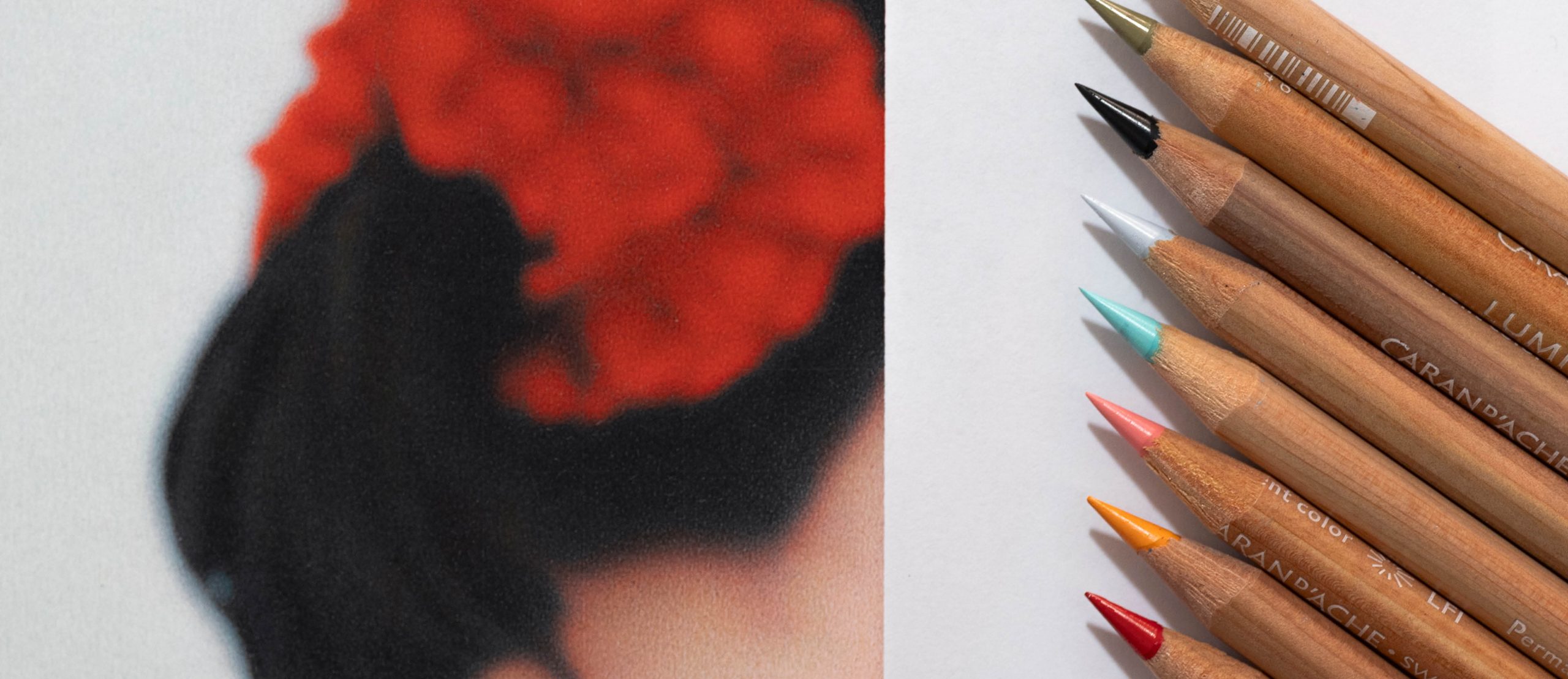
On the occasion of his exhibition (Des-)Estructurado at Alzueta Gallery Madrid, we spoke with Iván Franco about his artistic proposal. It includes works created from the remnants of the drawing process, such as shavings, graphite dust, and pigment, which the artist reassembles into autonomous pieces, in dialogue with his figurative works. This conversation brings us closer to the ideas and processes behind a practice that redefines the boundaries of the image.
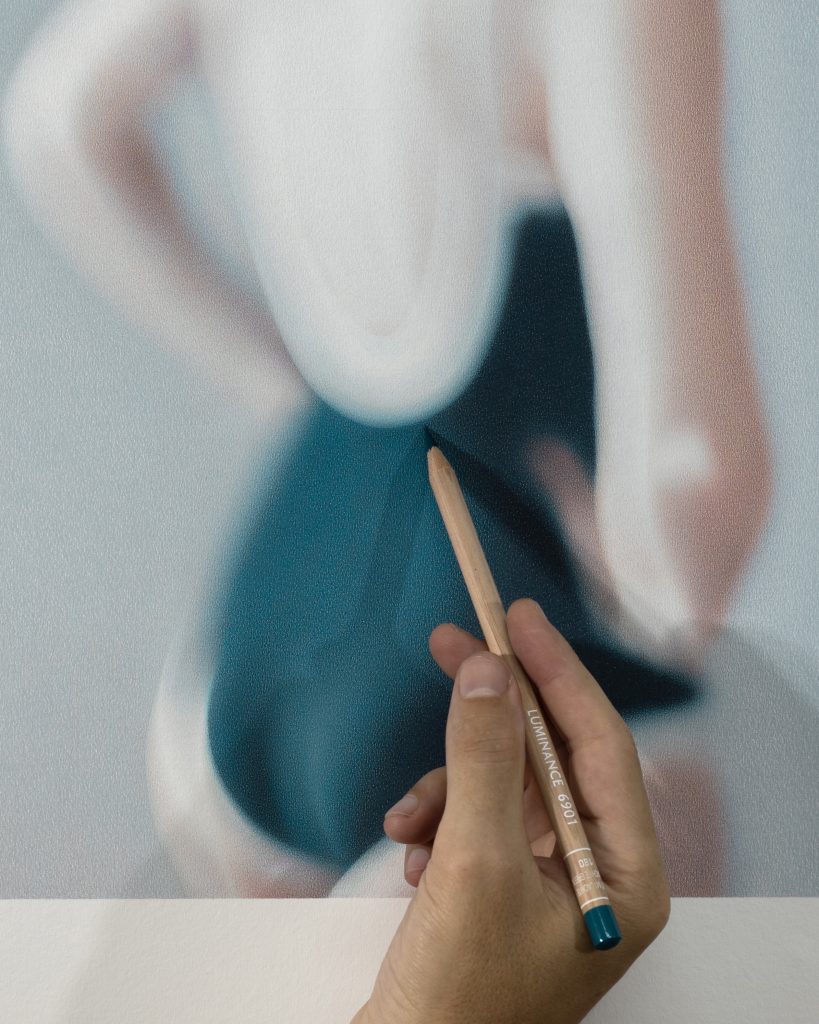
Alzueta Gallery (AG): In this exhibition, you continue to question the truthfulness of images by creating drawings based on slightly blurred photographs. What role does that blur play in the construction of your images?
Iván Franco (IF): In my work, I always try to highlight the duality between presence and absence. In the blur, we can sense silhouettes, but we can never fully define the shape. It’s as if the image were suspended, like a dream. It might also relate to the idea of memory, as if it were an attempt to preserve a time that is no longer in front of us.
AG: How did you come to the idea of using the material remnants of your works to create new ones? What was the process like, working with such a different medium and method to your usual approach?
IF: When I create my drawings, especially with colored pencils, sharpening them leaves behind wood and shavings that accumulate on a table next to me. . By the time the drawing is finished, this residue has built up considerably, forming a physical trace of the entire creative process. It’s almost like a material equivalent of what has been drawn on paper.
At first, I thought of it as something anecdotal. But over time, I realized it had a material and chromatic equivalence to what had been represented. I thought it would be interesting to transfer it onto paper at the same scale: one more deliberate and the other more unpredictable and less rational. This duality emphasises visual deception.This duality helps to emphasize that visual deception is nothing more than a balanced description of something not physically in front of us.
AG: When you reassemble the shavings, color combinations emerge that differ from those in the original drawing. What interests you about that difference?
IF: The color combinations are different because the pencil shavings are in their raw state. Depending on how much pressure you apply to a red pencil, for example, you can get several tones of that red. It all depends on how much of the paper you cover. The shavings retain the base pigment color.
It’s interesting how the works made from shavings are usually darker than their structured equivalents. That might be the biggest difference, beyond form or composition. The varying pressure applied during the drawing process causes a divergence, apart from the evident contrast between naturalistic and abstract form. What’s compelling is how these two very different processes are still connected by the conception of the same image.
AG: Would you consider the resulting work to be abstract? More broadly, what is your relationship with abstraction, as a figurative painter working on the edge of photography?
IF: The resulting work could be considered abstract, since it lacks a naturalistic reference and emphasises two-dimensional reflection on texture and colour. This two-dimensionality is a constant in my work as it is essential for exploring concepts such as simulacrum and visual deception. During my Fine Arts studies, I explored abstraction in some projects, and understanding its foundations shaped my current thinking about how we perceive reality in images.