Berni Puig: Between Murals, Studio, and Landscape Memory
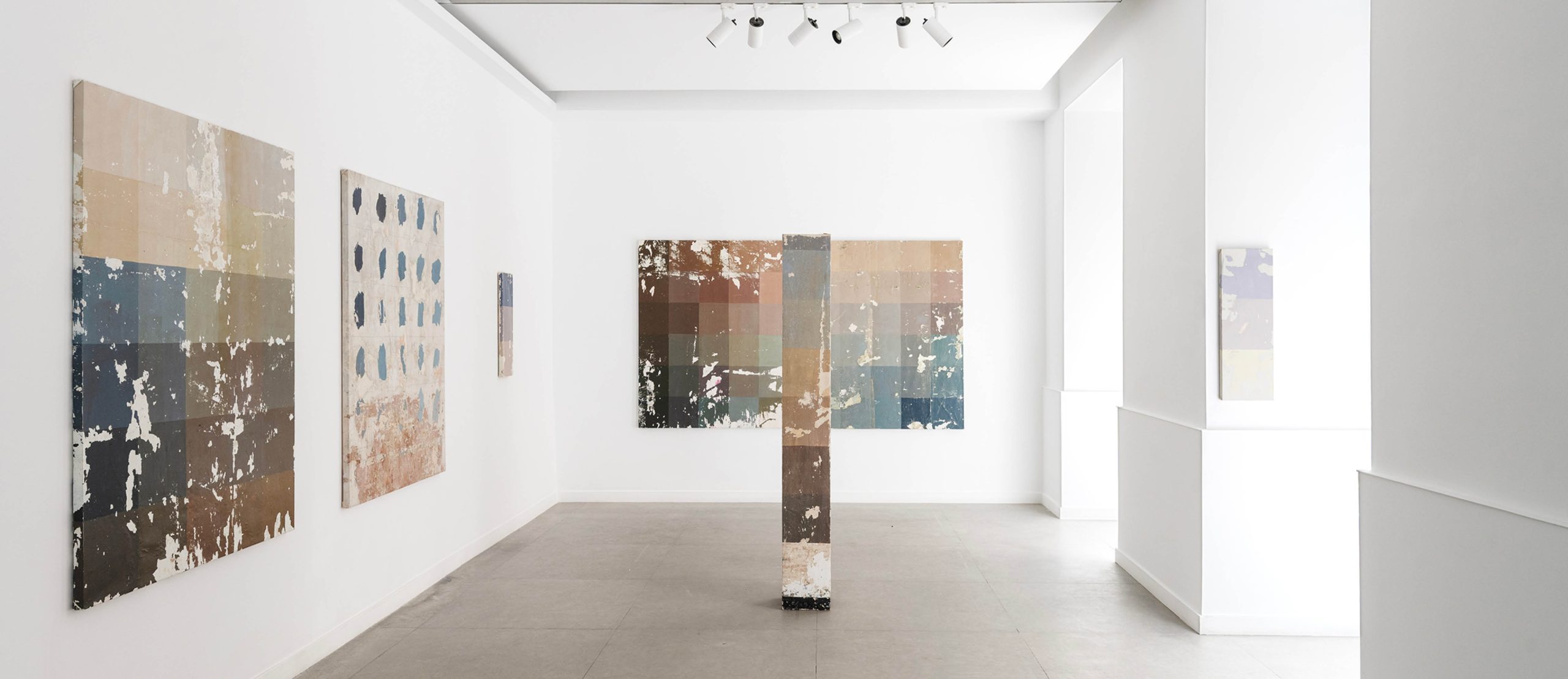
Alzueta Gallery Madrid presents Gotera, an exhibition by Berni Puig (Castellbell i el Vilar, 1990), on view from May 14 to June 16, 2025. Known for his hybrid practice between muralism and studio painting, Puig continues to explore the interplay between landscape, memory, and material through a distinctive visual language that includes works on canvas, wall interventions, and now sculptural forms. On the occasion of this new solo exhibition, we speak with the artist about his process.
Alzueta Gallery (AG): Your work manifests across various scales and media—from building walls to objects, and also through the more conventional format of painting. Despite these very different processes, what do all these practices have in common for you?
Berni Puig (BP): Every work begins outside the studio. Whether it’s a mural or a canvas, it all starts with chromatic studies of the landscape. When I travel or have time, I like to document how light shifts the colors in my surroundings. I have dozens of these studies saved on my computer, and they’re often the starting point for a new series. I need each piece to be connected to a lived experience—to a place I’ve visited or to a detail that surprised me. Without that connection, it’s very hard for me to begin working.
AG: What draws you to working in the studio, even though it lacks the sense of “adventure” that comes with, say, painting inside an abandoned building?
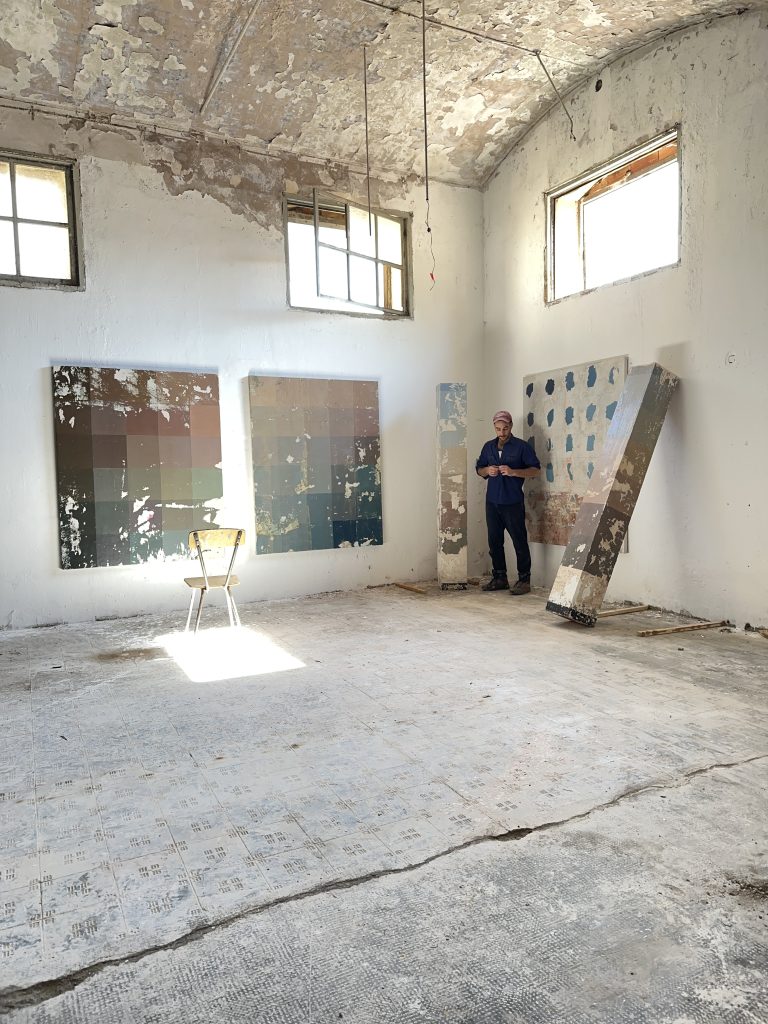
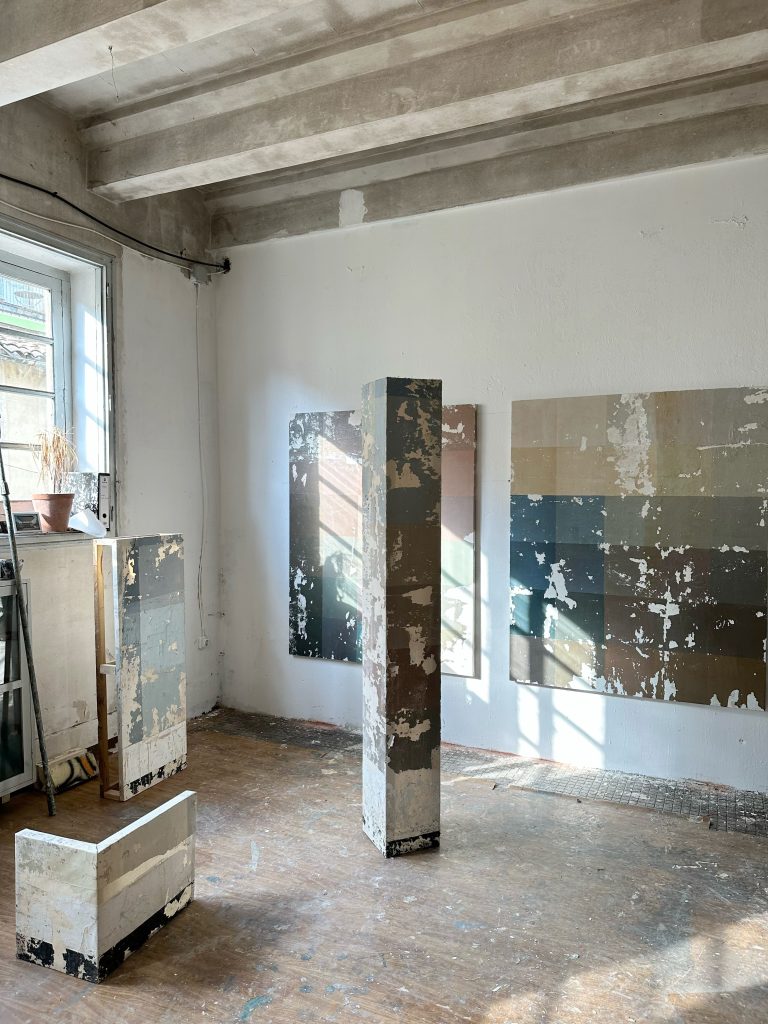
BP: In fact, the work arrives in the studio nearly finished. The process starts with color studies, which I then paint onto the walls of abandoned buildings near where I live. I settled into these spaces for a week or two, living there and painting directly onto the walls. Once I’m finished, I remove the paintings using the strappo technique and bring them, rolled up, back to the studio. That’s where I transfer them onto canvas. So, about 70% of the process happens outside the studio, and the sense of adventure is still very much present.
AG: You often use the strappo technique to transfer wall paintings onto canvas. How did this idea emerge, and what does it bring to your creative process?
BP: In 2020, I painted the interior of a church in Penelles, a village in inland Catalonia. Wanting to draw from Romanesque art, I read a lot about church painting and came across the strappo technique. Shortly afterward, I visited the mural paintings of Sant Climent de Taüll at the MNAC, which made a strong impression on me. A year later, in 2021, I began learning how to use the technique on abandoned factories in the Berguedà region.
Since then, it’s allowed me to connect with studio painting in a way that feels very natural. It helps me break free from the isolation of the studio and stay in touch with new environments, which is very motivating for me. Visually, my wall paintings are quite geometric and restrained, but when they’re removed, imperfections and accidents occur that bring an organic quality and texture. They’re two opposing processes, but they complement each other very well.
AG: Observing the landscape and the shifts in light and color is central to your work. You often start by taking photographs, from which you abstract color palettes that you then organize and paint. At that point, what is the criteria or tool you use to order the colors? Is it a scientific process, or is intuition involved?
BP: Once I have the timelapse photographs of a landscape, the process becomes very methodical. I use Illustrator to select the colors, following a method I’ve developed over time to be as precise as possible. That said, I know there’s still some margin of error, and for that reason I’m now working with a programmer who’s helping me automate the process. I want to increase precision and, above all, speed. If I can become more agile, I’ll be able to work with more layers of information and explore more complex chromatic ranges.
AG: You’re deeply connected to Konvent.0, a creative space located in a former textile colony along the Llobregat river. How do you think this very unique, off-grid location has influenced your practice?
BP: Right now, I feel like my work is genuinely rooted in this place. When I’ve done residencies outside Konvent, I often struggle to find flow. Here, both the landscape and the abandoned spaces I use are nearby, which makes my production rhythm much faster than when I work in a city. Also, Konvent is a very lively community, with a network of friends and artists who support each other. There are always new people coming for residencies, exhibitions—it’s a very stimulating environment.
AG: In Gotera you’ve included sculptural and ceramic pieces that go beyond the canvas. What does this three-dimensional aspect add to the project?
BP: When I paint in abandoned spaces, the murals adapt to architectural forms: they follow corners, columns, or the irregularities of the walls. When I remove them, they lose that dimensionality and become flat surfaces. Through sculptural and ceramic pieces, I try to recover that spatial quality, because it brings the work closer to how it originally existed before being relocated. It’s a direction I find very exciting and one that I want to keep exploring.