
Personal Picks: Ricard Molins
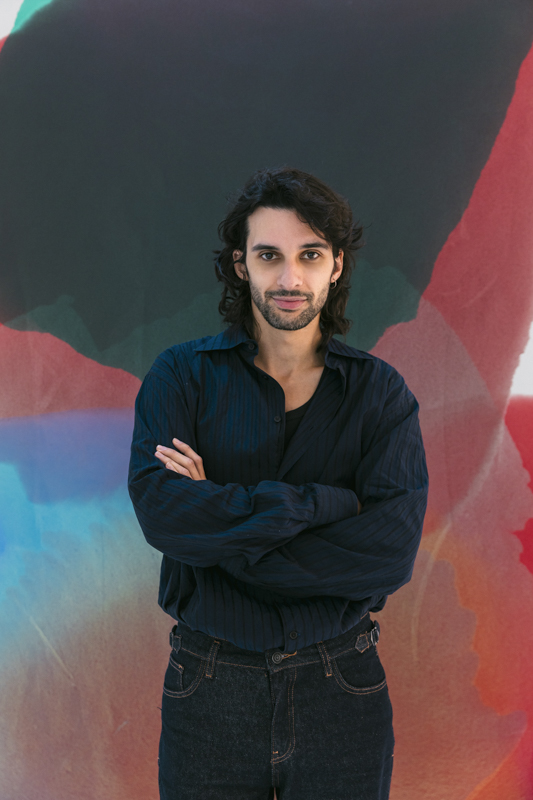
Personal Picks is a new format where someone from our team selects four artworks that resonate with them on a personal level. From intimate favorites to unexpected discoveries, each selection offers an individual, behind-the-scenes glimpse into the gallery’s evolving universe—one artwork at a time.
Next up: Next up: Ricard Molins, Head of Sales at Alzueta Gallery. With a background in Art History and a daily practice rooted in dialogue with artists and collectors, Ricard approaches art through the lens of intention, seeking to understand not only how a work is made, but why. His Personal Picks reflect this sensitivity: a selection shaped by his fascination with the studio as the true origin of every artwork.
For Ricard, visiting artists’ studios is not simply part of his work, but a way of entering the place where ideas take form, where doubt, intuition, labour, and experimentation coexist. Through these choices, he invites us to look beyond the finished piece and glimpse the spaces, processes, and atmospheres that silently shape the works we encounter in the gallery.
–
I remember that during my Art History degree, I realized that although I was interested in the formal and aesthetic aspects of art, what truly caught my attention was understanding the purpose behind the creation of those works, as it was the way to approach and comprehend the context in which they emerged.
We are used to observing, appreciating, and, one might say in today’s framework, consuming art once it is already hung, installed, and presented in a space specifically designed for it. A place that, far from decontextualizing the work, inserts it into a different discourse, and it is then that the wet canvas in the artist’s studio, when placed before the viewer’s eyes, begins to be “seen” as a work per se.
In this sense, having the privilege not only of meeting the artists but also visiting their studios where the works originate becomes a way to delve deeper and better understand their practice, allowing me to introduce and communicate it more effectively to collectors or the enthusiasts who are interested in it.
Moving away from the bohemian idea of the artist’s studio as a place where they wait for inspiration to arrive like an epiphany, the contemporary artist’s studio is a workplace -a place of hard work, countless hours, sketches of works that never were and never will be. Scenarios of certainty and insecurity, of trial and error. All of this not only ends up being reflected in the final result -the piece that reaches the gallery and is hung in the exhibition- but somehow remains embedded in the space where it was conceived.
It is then that the studio -whether a downtown apartment or an industrial warehouse on the outskirts of a big city- takes on its own identity that goes beyond being a mere workshop, becoming a reflection of the artist’s work and, ultimately, of the artist themselves.
That is why the common thread among the four selected works, beyond being an opportunity to talk about them and their creators, is an excuse to briefly peek into the spaces where they came to life. Spaces in which some artists, more deliberately, and others more accidentally, have left their mark, turning them into their own visual and inhabitable microcosm.
The first work is by Jordi Alcaraz, and aside from being first for alphabetical reasons in this selection, it happens to be the first studio I visited when I started working at the gallery, and one I hold a special memory of.
Jordi’s work is tactile and at the same time poetic. The feeling of his studio is closer to that of an industrial workshop, where you find Jordi manipulating and transforming the materials that appear in his works, ultimately bestowing them of a new visual and symbolic dimension and giving them a new reason for being once the piece is finished. The creation process of 9 lletres, like many of the artist’s works, might at first glance seem brutal, where the holes piercing the methacrylate have shattered its stillness, and the darkness of the black ink seems to trap that old book probably rescued from a flea market. Amid this chaos, Jordi manages to control it .
On the other hand, in Sabine Finkenauer’s work, everything seems more measured: each shape is carefully chosen, and together they have a final purpose that makes them mutate from geometry into something figurative, more recognizable for us. It is a visual language that reproduces objects and elements from our daily lives (a flower, a dress, a figure), sketched in notebooks the artist keeps in her studio where also every visual patron depicted in her work needs to be perfectly organized, so it can be found later. In Sabine’s studio, her own order prevails: every element has its place in a drawer or on a table, without interfering with the rest; just like in ‘Flor’, where each shape, each colour, has its assigned space on the canvas, a meticulous arrangement reflecting not only a visual logic but also the artist’s pursuit of harmony, where structure becomes the framework for poetic expression.
Untitled by Stan emerges as a tectonic piece. Weighty, yet at once pure and refined. The artist dismantles and reconstructs painting without relying on tools or instruments, but solely on the strength of her hands. It is a raw, physical approach that unfolds through successive layers, merging together elements from the earth gathered near her secluded warehouse on the outskirts of Lisbon, to the dust born of relentless activity in the studio. In this way, the very environment in which the artist works becomes deeply embedded in the piece, standing as a tangible testimony of the place where it was created.
Finally, Violeta’s case is quite particular because her studio, unlike the others, has been designed with the artist’s intention to serve as an extension of her works, of herself. It is dominated by sinuous, spherical forms, without edges, moving freely throughout the space, just like the paint that flows freely over her works. In El gusanillo del vértigo II we see rivers of paint spreading arbitrarily across the surface, where the artist has let herself go, neither knowing nor wanting to know what the final composition will be, but simply enjoying the process of capturing on the canvas an emotional and intimate state. A process that serves the artist as a pause and a moment ,which is always welcome, for introspection and inner listening.
Ricard Molins
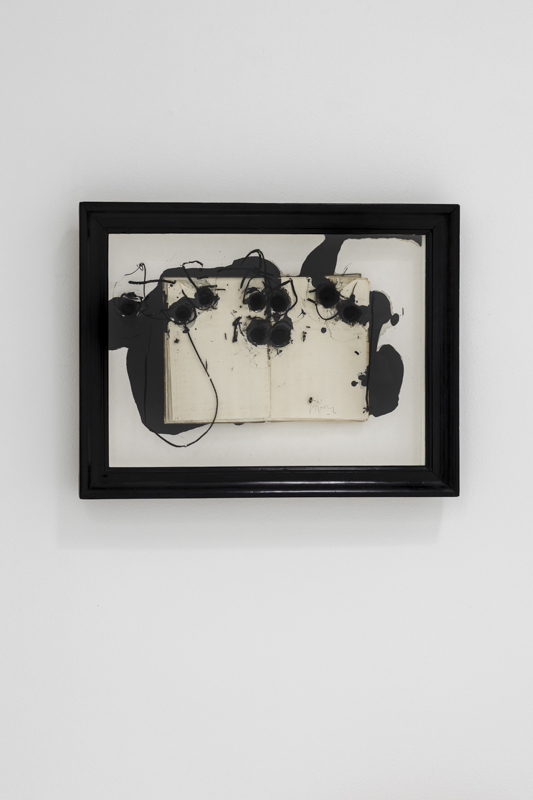
Jordi Alcaraz
9 lletres, 2025
Painting and grease pencil on book and methacrylate
56 x 73 x 7 cm
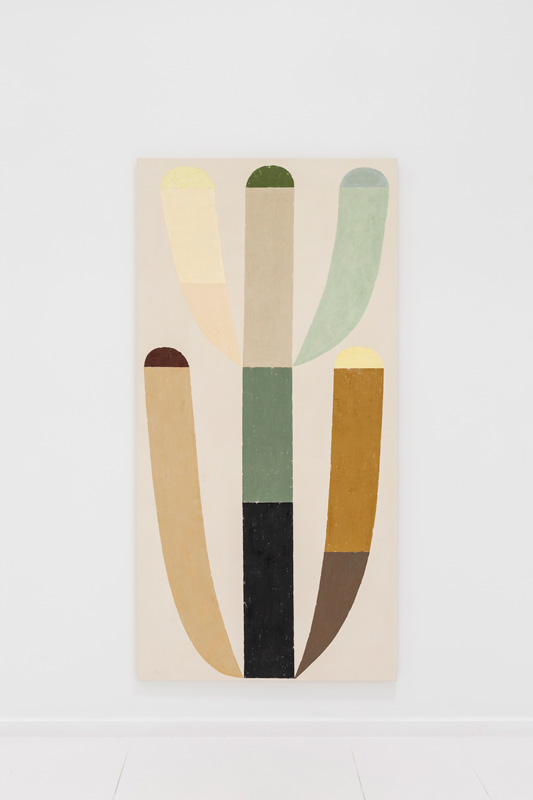
Sabine Finkenauer
Flor, 2025
Oil pastel on canvas
195 x 97 x 3 cm
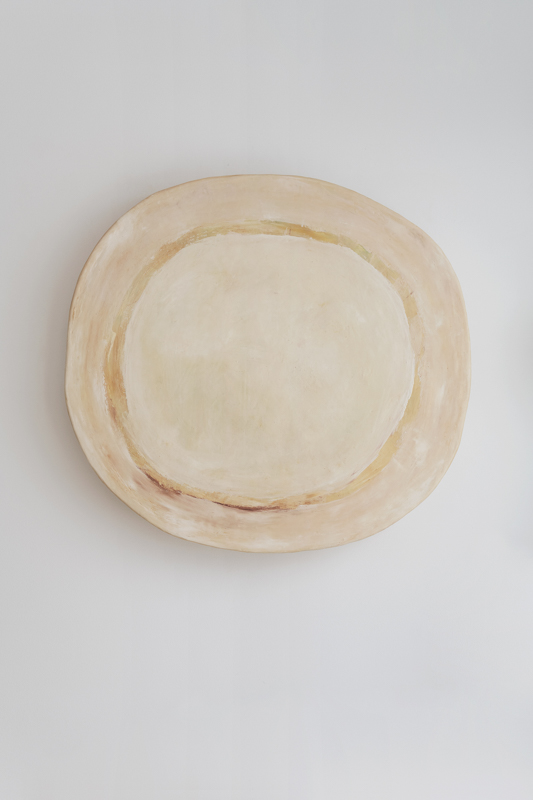
Stan Van Steendam
Untitled, 2022
Varnish, pigments, dust, dirt, plaster and epoxy resin on wood
136 x 129 x 19 cm
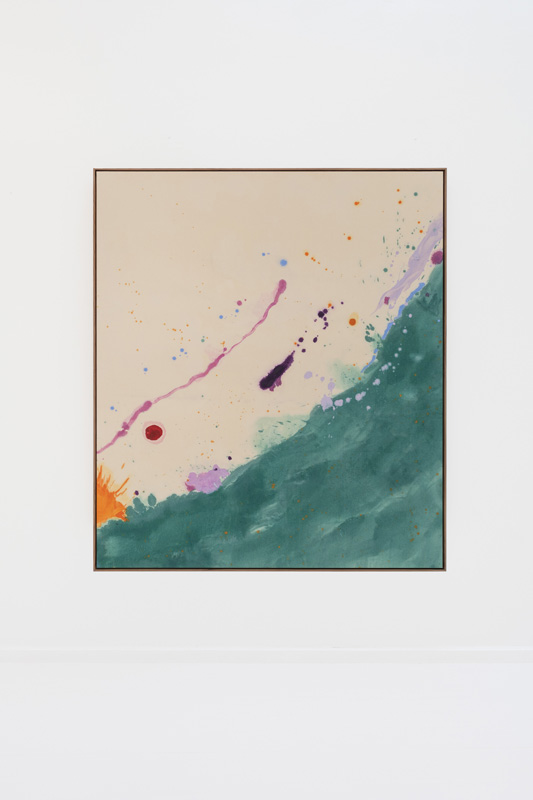
Violeta Maya
El gusanillo del vértigo Il, 2024
Pigments and acrylic on canvas
234 x 204 x 5 cm (framed)