Studio Visit: Aythamy Armas
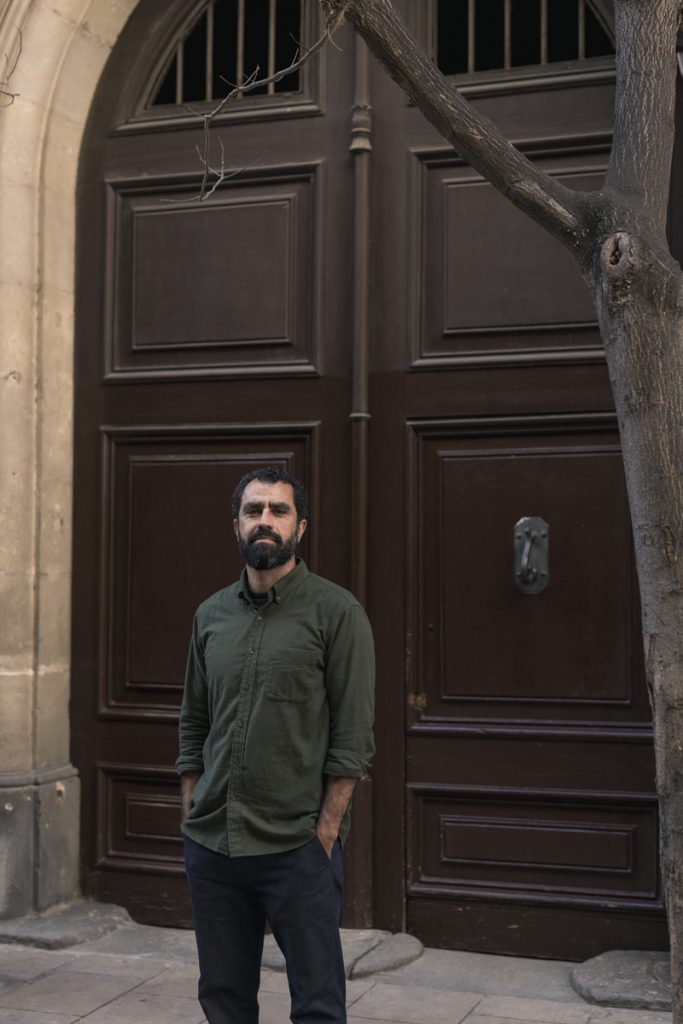
Right in the centre of Barcelona, just a few steps from La Rambla but tucked away in a quiet passage, Aythamy Armas welcomes us into his studio. An intimate space where matter, gesture, sound, and silence coexist.
Alzueta Gallery (AG): What’s your studio routine like?
Aythamy Armas (AA): I don’t have a fixed time to come in. I try to keep a good morning routine: go for a swim, have a good breakfast… I come in almost every day of the week and spend many hours here, but without a rigid schedule. I used to be more strict about it, but over the years I’ve learned that having a good life outside the studio also has a positive impact on the work I do inside.
AG: Tell us a bit about your studio.
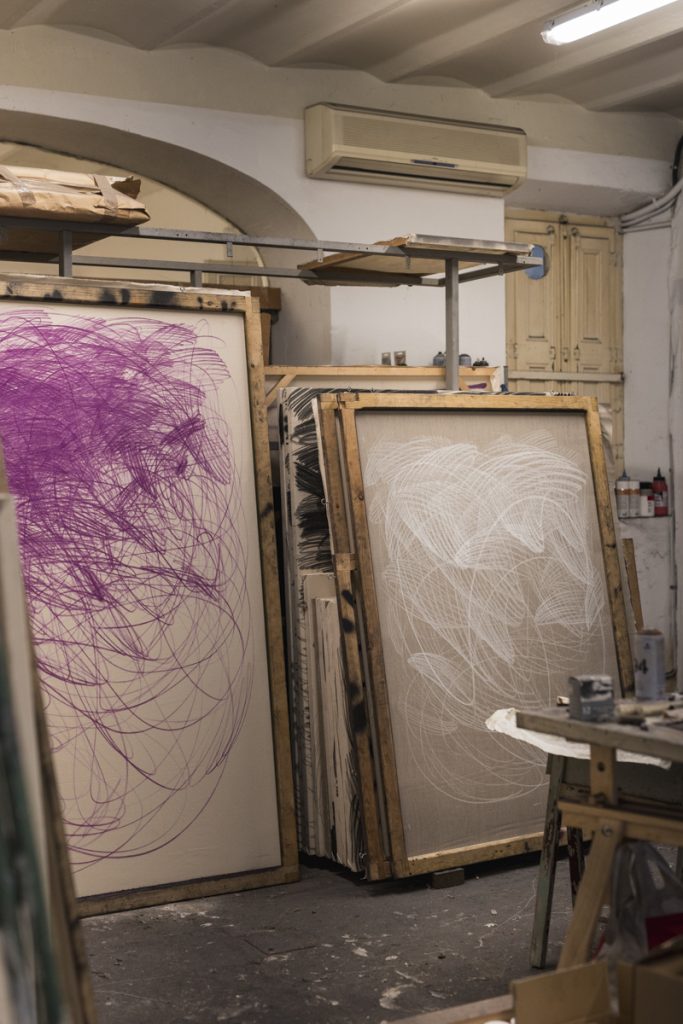
AA: The studio is in the Gothic Quarter, on Passatge de la Pau, a beautiful, quiet street with very special buildings, just next to La Rambla. Even though the area is very busy, this particular street allows me to work in peace. It’s a small place, but it has a patio that lets in natural light, which creates a very specific energy. It used to be an architecture studio run by some friends of mine, and I was already fascinated by it back then: the street, the entrance, the building, the patio… The atmosphere always felt very special to me.
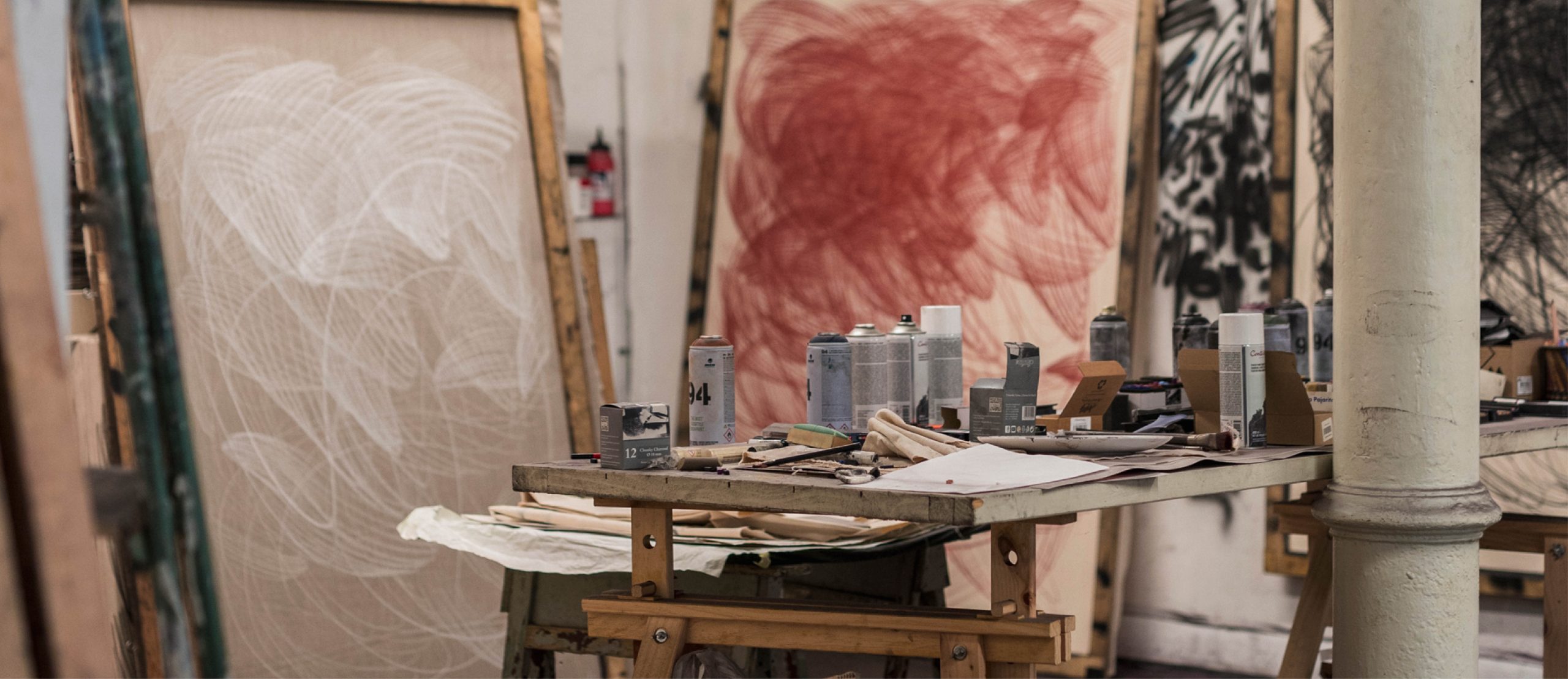
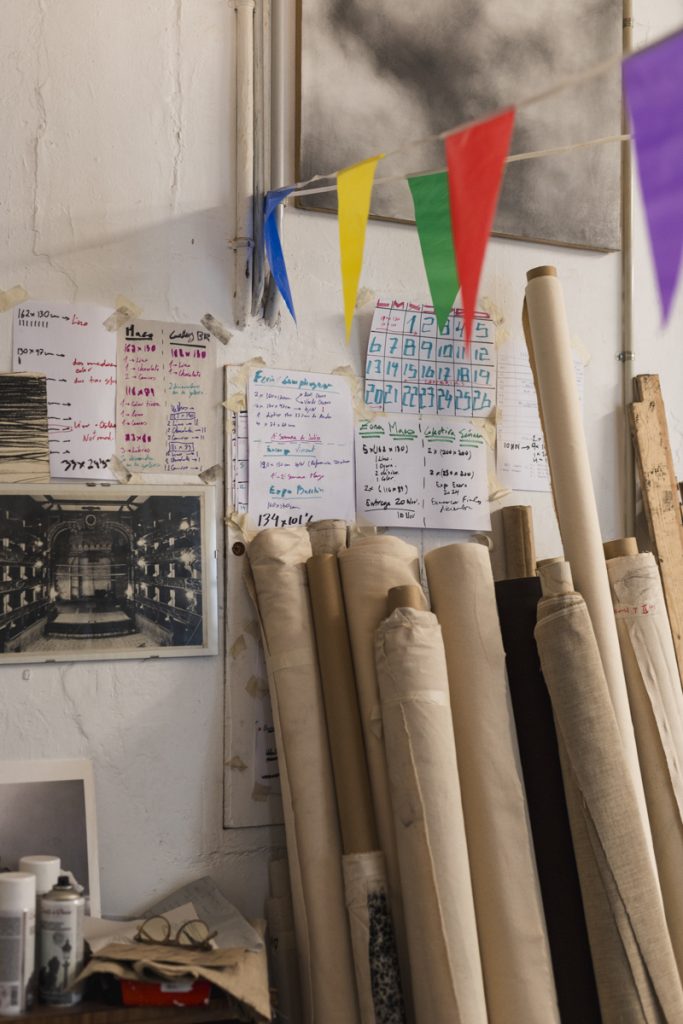
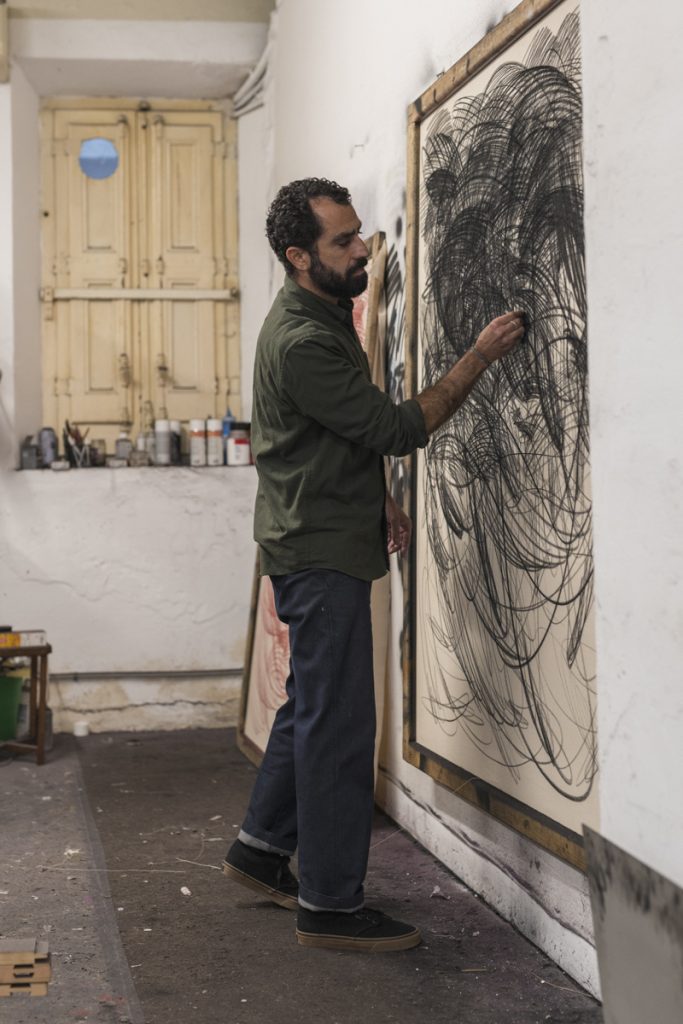
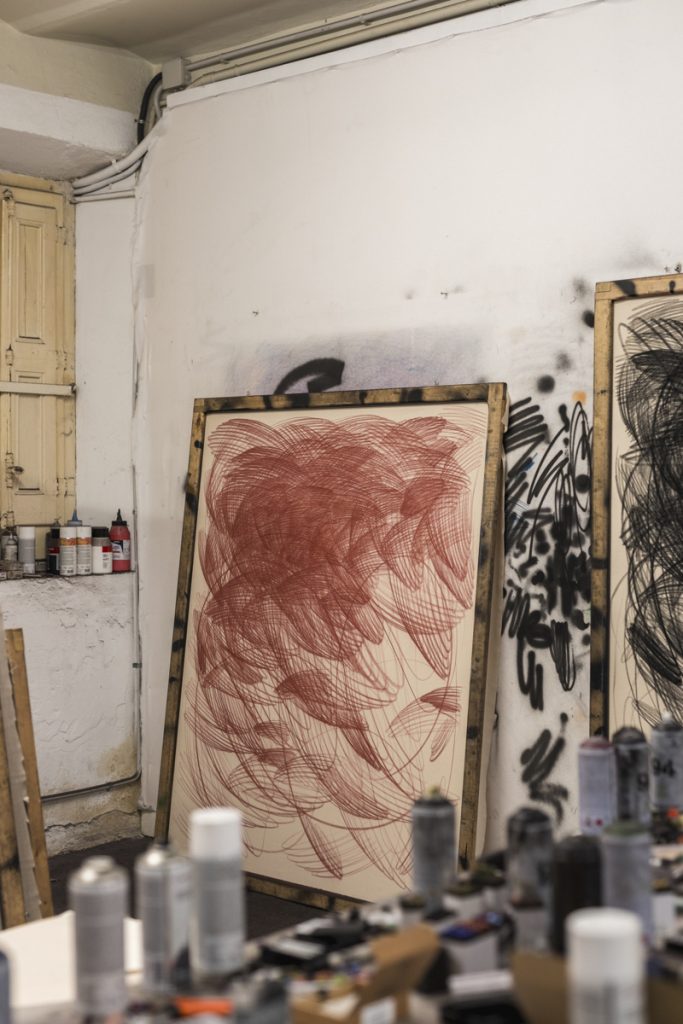
On the walls I hang the canvases I’m working on. One wall is dedicated to medium-sized formats (like the ones I have now), and a larger one is reserved for large-scale pieces. I usually work with dry techniques: pastel, conté, charcoal… on raw fabric, either cotton or linen. This combination gives me a special warmth, very different from painting on prepared canvas.
I usually work on several pieces at the same time, distributed throughout the studio by size: small, medium, and large. I always keep a clear area of the studio to photograph or store finished works. This organization allows me to move between paintings, to step back from one and come back with a new perspective.
AG: What role does space play in the physicality of your work?
AA: Space has a big impact. Having a large wall has allowed me to create pieces that require broader body movements. Space both limits and enables; it forces me to think about the work from the body.
AG: How would you define your visual language?
AA: One of the aspects that matters most to me is the identity of the work through a personal language. A language made of “words”: the strokes, the tools, the materials… These words form sentences, and the sentences are the paintings.
Over time, this language evolves. Some “words” disappear, others are added. Sometimes I rediscover elements from years ago that still feel relevant, and I bring them back into the new language.
AG: How do you understand composition within that personal language?
AA: At first, gradients or horizons were key in my work. Over time, the stroke has become freer and more central. As the stroke becomes more central, so does the movement of the body when drawing.
When I look at my paintings, I perceive the rhythm, the movement of the hands and the body. I seek a certain wholeness in the composition, but I’m also interested in introducing visual accents that break the base structure. I do this by concentrating more material in certain areas, playing with the finish and thickness of the stroke.
AG: Do you listen to music while you paint? What’s the relationship between gesture and sound?
AA: Rhythm is essential, especially now that the stroke has taken on more importance. I used to always work with music. Now I prefer silence: it lets me hear the sound of the canvas, of the stroke, and be more connected to the material.
This way, I also appreciate music more when I hear it outside the studio. In my project Linesound, I explored precisely that relationship: I used a synthesizer to translate the movement of the stroke into sound. I’m interested in how a line can become a sound wave.
AG: And to finish the interview, tell us a funny anecdote about the studio.
AA: When I moved in, the floor was white. Now it has changed color and is covered in charcoal dust. I always say that charcoal is like a virus that invades everything. It’s funny how the studio itself changes along with the work.